Sport promotes encounters between people of diverse social, cultural, and ethnic backgrounds – thus, it can play a crucial role in integration. Germany is known as a sports nation with a long tradition of clubs. Millions of people here play sports in clubs in their free time, from small local clubs to large Bundesliga clubs. This article provides an up-to-date overview of the structure of the sports system in Germany – from the grassroots sports clubs to the sports federations and the umbrella organization – and highlights the significance of this system for society and the integration of migrants.
The Importance of Sports Clubs in Germany
Sports clubs form the foundation of organized sports in Germany. Unlike some other countries (such as the USA, where sports are often tied to schools and colleges), sports here predominantly take place in clubs. A sports club (usually as a registered association, e.V.) is a voluntary community where people play sports together. These clubs are primarily run by volunteers and are financed through membership fees, donations, and often support from municipalities (e.g., in the form of providing sports facilities).
The numbers speak for themselves:
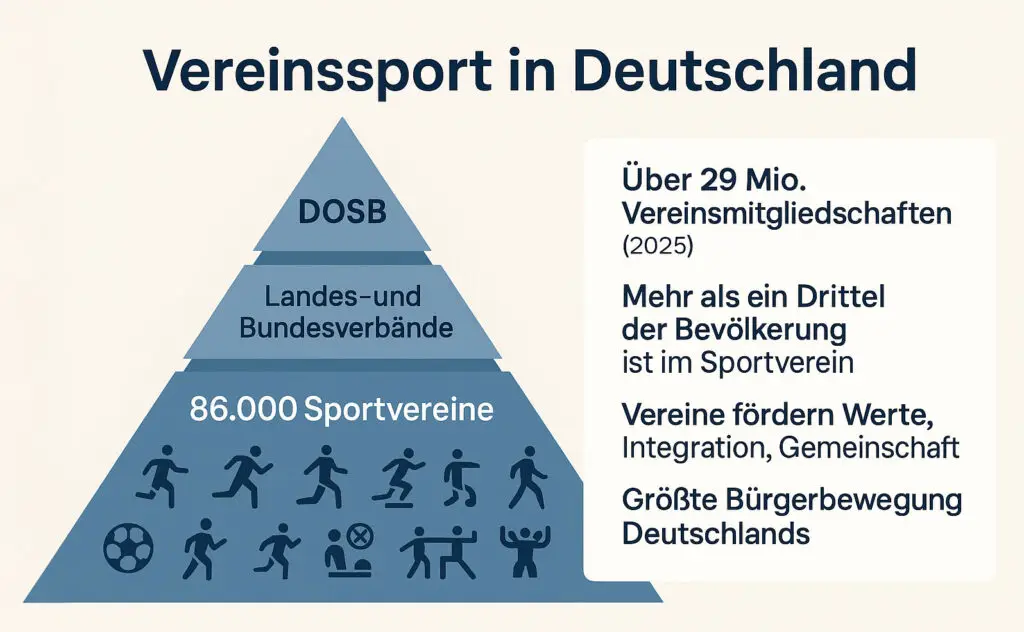
More people than ever before are playing sports in clubs in Germany – by early 2025, over 29 million club memberships were registered for the first time. The approximately 86,000 sports clubs in the country thus unite over a third of the population. Sports clubs are present in almost every community and offer activities for all age groups and interests: from football to gymnastics and athletics to niche sports. In addition to sports activities, these clubs also fulfill important social functions. They foster community, impart values, and enable people to be active together across generations. It’s no coincidence that non-profit sports are considered Germany’s largest civic movement.
Organizational Structure: Clubs, Federations, and Umbrella Organization
The structure of sports in Germany is hierarchically and federally organized. At the grassroots level are the local sports clubs – numbering around 86,000–90,000 – where sports activities actually take place. These clubs join together at various levels to form federations to consolidate their interests and organize competitions. Essentially, two types of federations are distinguished:
- Sports-specific federations: These are federations for individual sports at regional and national levels. For example, football clubs belong to their state football association, which is subordinate to the German Football Association (DFB) as the national federation. Similarly, there are specialized federations for gymnastics (DTB), athletics (DLV), handball (DHB), and many other sports. These federations implement the rules of their sport, organize leagues and competitions, and represent the interests of the sport externally. Some German national sports federations are even the largest in the world in their respective sports – for instance, the DFB, with over 7 million members, is the largest football association worldwide.
- State Sports Confederations: Parallel to the sports-specific structure, there is a State Sports Confederation in each federal state at the territorial level. These State Sports Confederations unite all sports clubs in a region, regardless of the sport. They serve as the general representation of sports clubs to politicians (especially the state governments) and support local clubs, for example, through training, consultations, or the administration of funding. There are 16 State Sports Confederations (for the 16 federal states).
At the top of organized sports is the German Olympic Sports Confederation (DOSB) as the umbrella organization. The DOSB currently unites 99 member organizations (as of 2023). These include the 16 State Sports Confederations (territorial federations) as well as currently 66 national sports-specific federations (for Olympic and non-Olympic sports) and 17 federations with special tasks (e.g., the General German University Sports Federation for student sports). The DOSB is thus the largest sports organization in the world in its field. Among other things, it is responsible for sending German Olympic teams, developing strategies for sports, and representing the interests of German sports internationally. Despite this central role, the DOSB is not a state body, but an independent non-profit association – a true non-governmental organization of sports.
How do these levels interlock? A sports club is usually a member of its respective sports-specific federation and, through it or directly, also a member of the State Sports Confederation. For example, a local multi-sport club could simultaneously belong to the Bavarian State Sports Confederation and, with its football department, be a member of the Bavarian Football Association (and thus the DFB), with its gymnastics department in the Gymnastics Federation, etc. Through this structure, interests are bundled bottom-up: Clubs elect delegates to federation councils, federations meet at state and federal levels, and finally, everyone comes together in the DOSB. Decisions are thus largely prepared from the grassroots of sports – an expression of the principle of autonomy in German sports.
Volunteering and State Support in the Sports System
A characteristic of the sports system in Germany is the high degree of self-responsibility and volunteerism. Sports clubs are mostly independent of state influence and organize themselves – this principle of autonomy has historical reasons and is considered a guiding principle of sports policy. Millions of citizens volunteer in clubs as trainers, coaches, or club board members. Without this volunteer work, widespread sports activities would be unthinkable. Around 8 million people volunteer in German sports clubs – they lead unpaid training sessions, organize competitions, manage the club, and take care of youth work. This civic engagement not only promotes sports itself but also strengthens social cohesion locally.
The state (at municipal, state, and federal levels) plays an important supportive role, but acts subsidiarily. This means that state bodies primarily intervene to help where sports organizations cannot manage on their own. Public funding exists, for example, in the form of providing and maintaining sports facilities by cities and municipalities, subsidies for grassroots sports and youth work through state programs, or the financing of elite sports and Olympic preparation by the federal government. Organizationally, however, sports is not an explicit state goal in the Basic Law, and there is no separate federal ministry for sports – sports usually falls under the purview of the interior ministry or the respective states. However, the cooperation between politics and sports is close: representatives of sports federations sit on sports policy committees, and there are regular consultations, for example, concerning school sports, sports promotion, or major sporting events. Overall, the principle is: Sports organizes itself, but the state and society create the framework conditions so that clubs can perform their important work.
Sport as an Engine for Integration
Sports clubs are not only places for physical activity but also important meeting spaces for people from various population groups. Especially for immigrants, clubs offer an excellent opportunity to find connections in their new home. During shared training and in team spirit, contacts and friendships emerge without language barriers being a primary concern – in sports, togetherness and fair play are what matter most. Studies show that sports help break down prejudices and foster mutual understanding.
However, it also shows that people with a migration background are currently less often members of sports clubs than the population average. Especially in volunteering (e.g., as trainers or on club boards) and among girls and women with an immigration background, there is still room for improvement. Reasons for this can be language barriers, lack of information, or cultural differences. To overcome these barriers, numerous initiatives and funding programs exist. The federal program “Integration through Sport” has existed since 1989, through which the DOSB and the federal government specifically improve opportunities for participation. Today, this network is more diverse than ever: Several thousand sports clubs across Germany offer special programs for migrants and refugees – from intercultural sports groups and club sponsorships to the training of coaches with a migration background. Projects like the DOSB’s “Welcome to Sports” offer easily accessible support for refugees to find their way into clubs. Almost a third of clubs have been involved in refugee integration in recent years, and about one in five clubs has developed special programs for refugees.
For many newcomers, sports clubs are a piece of home: Here, one can practice the German language playfully, learn local customs, and at the same time do something for one’s own health. The successes are visible – from football teams with players of diverse origins to inclusive sports festivals that bring entire neighborhoods together. Sports in clubs not only boost fitness but also stand for respect, team spirit, and belonging, as DOSB President Thomas Weikert emphasizes. These values help all members – whether with or without a migration background – and foster true social cohesion.
Conclusion
The sports and club structure in Germany is a successful model that unites grassroots sports, top performance, and integration under one roof. From the local level of sports clubs to the national umbrella organization DOSB, a dense network extends, supported by committed citizens. For migrants, this system offers great opportunities to become part of the community: Sport connects! Through the combination of volunteer commitment and supportive funding, it has been achieved that today over 29 million people play sports in clubs – and the trend is rising. Sportdeutschland (Sports Germany) welcomes everyone who wants to participate and play along, demonstrating daily how integration can succeed through shared hobbies.
Sources:
The information in this article was taken, among other sources, from publications by the German Olympic Sports Confederation, the Federal Agency for Civic Education, and the Federal Government Commissioner for Integration. These substantiate the mentioned data and statements regarding the structure of sports and the importance of sports for integration in Germany.